Mohak Garg
Back to projects
Personal Project
2026

TimeMesh: Group Scheduling Tool

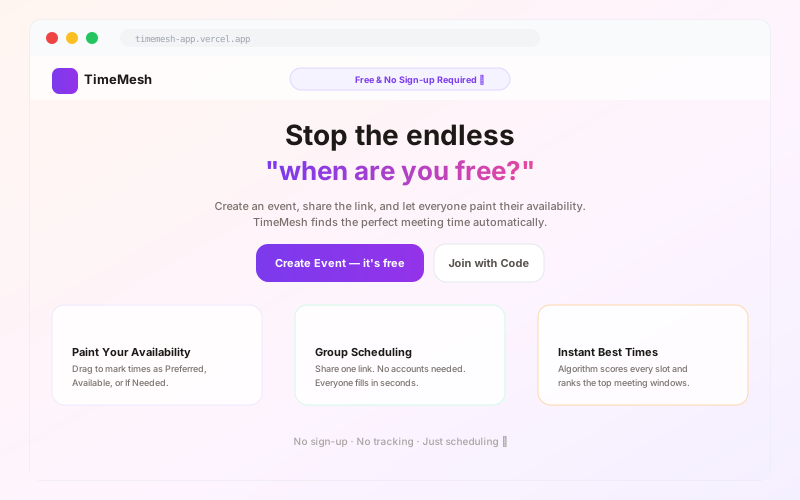
No-signup, link-based group availability tool that finds the best meeting time automatically.

Product Manager & Engineer — Discovery, UX Design, Full-Stack Development, Deployment

Next.js
PostgreSQL
TypeScript
Product Strategy
Algorithm Design
Mobile UX
Zero
Signup required
24+
Time zones supported
Live SSE
Real-time updates
The Problem

Group scheduling tools like Doodle and When2Meet are cluttered, require everyone to sign up, or fail to handle real-world complexity — multiple time zones, availability nuance, and messy back-and-forth in group chats. Students coordinating group projects and professionals managing cross-team syncs face the same friction: no tool makes it fast and frictionless for everyone involved.

The Solution

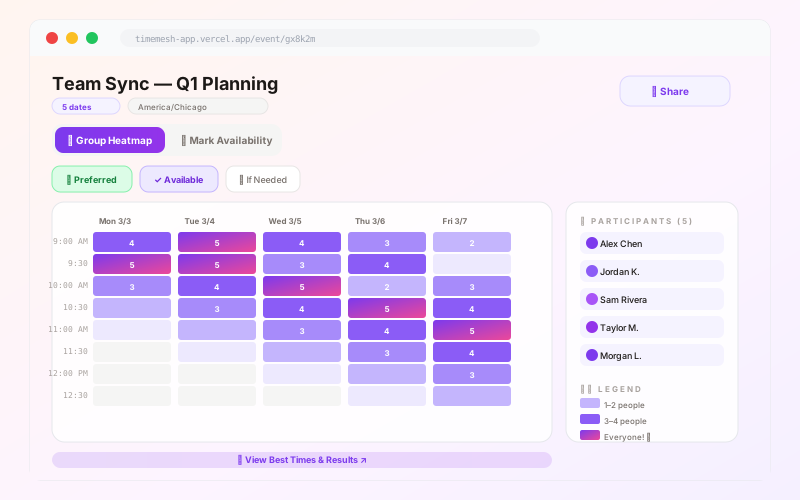
Built TimeMesh — a no-signup, link-based group availability tool. Participants paint their availability on a visual grid (Preferred / Available / If Needed), and the algorithm surfaces the best overlap automatically with a live real-time heatmap. No accounts required for participants.
Screenshots

TimeMesh Landing Page
Group Availability Heatmap

Product Artifacts

Live Site
Try it live
Open
GitHub
Source code
View

Case Study

Context
  • Group scheduling is a universal pain point — coordinating 5+ people across time zones generates endless 'when are you free?' messages.
  • Existing tools like Doodle and When2Meet require accounts, have poor mobile UX, or treat all availability as equal with no priority weighting.
  • Students face this every semester for group projects; professionals face it every week for cross-team syncs.
  • The core job-to-be-done: find the best meeting time with zero friction for every invitee.
Decision
  • Scoped ruthlessly to the core loop — create event → share link → paint availability → see best time. Cut account creation, notifications, and calendar integrations from MVP.
  • Chose a drag-to-paint interaction model over checkbox grids to make availability entry fast and visual.
  • Implemented three-tier priority system (Preferred / Available / If Needed) so the algorithm weights overlap quality, not just quantity.
  • Used Server-Sent Events for real-time updates so participants see each other's availability live without polling.
  • Chose Next.js + PostgreSQL on Vercel for zero DevOps overhead and a shareable URL from day one.
Execution
  • Conducted competitive analysis across Doodle, When2Meet, Calendly, and LettuceMeet to map UX gaps and opportunity space.
  • Designed a drag-to-paint grid interaction that works across desktop and mobile with touch event handling.
  • Built a weighted scoring algorithm that ranks time slots by Preferred > Available > If Needed priority levels.
  • Shipped 24+ timezone support so the event creator sets the reference timezone and participants see slots in their local time.
  • Implemented live group heatmap with SSE so availability overlap is visible in real time as participants fill in.
  • Shipped QR code sharing and event codes for frictionless invite distribution.
  • Deployed on Vercel with auto-aliasing on every push — zero manual deployment steps.
Outcome
  • Live product at timemesh-app.vercel.app — no signup required for participants, shareable in seconds.
  • Real-time availability updates across all participants using Server-Sent Events.
  • Mobile-responsive grid handling 6+ dates without UX degradation on any screen size.
  • Immediate adoption by classmates for group project scheduling with zero onboarding required.
Learnings
  • Constraint is a feature — removing account creation wasn't a limitation, it was the product's biggest differentiator. The constraint forced a better UX decision.
  • Touch UX is a first-class engineering problem — drag-to-paint felt natural on desktop but required intentional solutions for mobile: touchAction conflicts, scroll vs. paint interaction, and cell sizing all needed separate fixes.
  • Ship fast, validate faster — getting a live URL into a group chat is worth more than a month of design iteration. Real usage revealed UX issues no prototype would have caught.